Let’s start with a single figure, because it makes the case for this final foundation more plainly than any argument could. One MGA we have worked with reduced its technology spend from 1.5% of gross written premium in year one to 0.6% by year three. Same business, rapidly growing portfolio, and a cost of technology that fell, as a share of premium, by roughly 60% over the period.
It is a figure that runs against the grain of how many businesses behave. Ordinarily, growth brings cost with it: every new product, every expansion, every extra hand adds to the running total, and margin absorbs the difference. This is the reverse. In this scenario, cost decouples from growth.
That is the essence of the fourth and final foundation of a peak-performing MGA: operating economics; and in changing markets, it may be the one that separates the businesses that grow from those that simply survive.
Why this matters so much for MGAs
The MGA model is, fundamentally, a margin business. When rates and premiums are rising, there is room in that margin to absorb a good deal of operational inefficiency. When rates are falling, that room disappears, and the discipline of the cost base becomes decisive.
The arithmetic is one every MGA leader knows well. Since MGAs retain only a relatively modest percentage of the premium that flows through them, the cost of running the business, and technology is a significant part of it, has an outsized effect on what actually reaches the bottom line. That is why technology spend running well above 3% of GWP increasingly reads as a signal of constrained architecture rather than of scale: a platform that costs more to maintain the bigger it gets, rather than one that compounds. The benchmark we see among peak performers is technology spend below 1% of GWP.
The distinction that matters is between a platform built to maintain and a platform built to compound. The first is a cost base that grows with you. The second is an asset that strengthens with every product, division and acquisition you add to it, making each subsequent launch faster and more cost efficient than the last.
Automation is the mechanism
The lever that makes this possible is intelligent automation, specifically of the repetitive, high-volume work that would otherwise require ever more people as the book grows. When a large proportion of the quote-to-bind journey is automated, although still with the human-in-the-loop, the business can write substantially more premium without a proportional increase in headcount or operational cost.
The pattern across a portfolio
The high-growth MGA noted at the beginning of this article is not an isolated case. When we look across a set of high-growth MGAs, the pattern holds: the strongest performers see their unit economics improve markedly over time, and the top performers grow substantially while their cost of technology, as a share of premium, falls. The very best reach operating economics rarely seen in the insurance industry, and that rarity is exactly the point. It is a durable competitive advantage, and one that is very hard for a business on constrained architecture to replicate.
When the platform itself becomes the asset, every acquisition an MGA group makes, every new division it launches, every product it adds, strengthens the whole rather than fragmenting it. For consolidating MGA groups in particular, this is the difference between an accretive acquisition strategy and one that quietly accumulates technical debt and integration cost with each deal.
The number worth putting on the boardroom wall
Of the four foundations in this series, operating economics does not generate headlines the way a fast product launch or a new distribution deal does. But it is the foundation that determines whether growth is actually creating value or quietly consuming it.
So the question to end on is a simple, numerical one. What is your technology spend as a percentage of your managed GWP, and which way is it heading as you grow: up with every new product, or down as the platform does more of the work? That single figure, and its trajectory, tells you most of what you need to know about where you sit on this foundation.
See how your MGA is performing
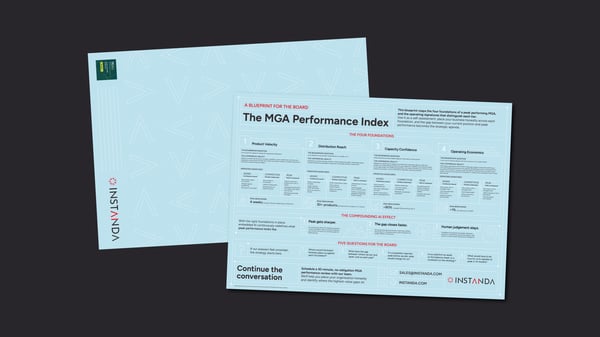
To see where your business sits across all four foundations, the MGA Performance Index offers a short, board-level self-assessment and an honest read on where your highest-value opportunities lie. It takes less than 2 minutes, and it is a genuinely useful place to begin the conversation about where to focus next.