.png)


Here is a scenario that will be familiar to anyone who has scaled an MGA. You have a product that works. It performs well, the brokers like it, and the loss ratios are healthy. Naturally, you want to extend it: into a new region, through a new channel, with a new distribution partner. Some of it comes across relatively easily. But some of it, you discover, must be built again. A new integration for a specific broker. A fresh configuration for a new geography. A separate effort for a particular channel.
Individually, none of these is alarming. But multiply the parts that do not travel across a growing business, and you arrive at a quiet drag on growth. Each expansion carries some rebuild cost, and the more successful you are, the more of it you accumulate. The proportion of any given move that you can genuinely reuse, versus the proportion you have to recreate, turns out to be one of the most telling things about an MGA's ability to scale, and one of the most common places we see capable businesses held back.
Very few MGAs replicate everything effortlessly, and very few rebuild everything from scratch. Most sit somewhere in between, able to reuse some things cleanly while others still demand real effort each time. The useful question is where you sit on that spectrum today, and in which direction you are moving.

Distribution is where ambition meets operational reality
Distribution is, in many ways, where an MGA's strategic ambition collides with its operational reality. It is easy to say, "we want to be multi-channel, multi-region, multi-partner." It is much harder to build a business that can deliver without the cost and complexity rising in lockstep with the ambition.
The strongest MGAs have moved a long way along this spectrum, treating distribution as far more of a replication challenge than a construction one. They create a replicable operating model, then extend it across products, channels and geographies with as little starting from scratch as possible. A new partner is, wherever it can be, a matter of configuration rather than a bespoke integration. A new region is adapted rather than rebuilt. Onboarding that once took weeks takes days, or hours. They will never eliminate bespoke work entirely, some partners and some markets will always demand it, but they have pushed the balance decisively towards standardization at scale.
The benchmark we see among peak performers is striking: products replicated across mulitple regions and states in a single year, onboarding measured in minutes and hours rather than weeks, and a genuine ability to enter new markets in multiple languages and currencies without a ground-up build each time. That is not a distribution operation running to keep up with the business. It is a distribution operation that actively accelerates it.
Replication in Practice
Flow Flood Insurance offers a clear illustration. Flow Flood set out to create a digital flood marketplace, integrating multiple flood syndicates and NFIP rates so that agents could quote, bind and renew in minutes rather than wrestling with multiple platforms and long processes. The results speak to the point: agent onboarding fell from ten days to mere minutes, and the business tripled its agent base within four months.
But it is what happened as they scaled that is most telling. Flow Flood launched in 18 states with expansion to a further 24 within a year, and the configurable architecture enabled them to adapt to complex, varying regulation across those states without rebuilding the system each time. Flood insurance is a notoriously regulation-heavy line, with rules that differ meaningfully by jurisdiction. Being able to replicate the proposition across all of them, flexing for local compliance rather than starting again, is precisely the capability this foundation describes.
Another example, a specialist MGA operating in mergers and acquisitions insurance makes a similar point from a different angle. M&A insurance involves some of the most complex, bespoke transactions in the market, and this business set out to scale its platform across Europe, the US and Australia. The initial product was built in under four months, and subsequent products now deploy in around six weeks using the same underlying architecture. As its COO has described it, once the first product was live they had a proven blueprint they could scale across territories without starting from scratch each time.
What both examples share is a determination to make growth mean as little duplication as possible. The channel-and-geography-agnostic approach they have taken is one of the genuine competitive advantages available to an MGA today.
The demand side of distribution
There is, of course, another market dimension that is easy to overlook. Brokers are increasingly clear about what they want, and one consistent message is a desire for more e-traded products and low-friction ways to place business. An MGA whose distribution architecture lets it stand up new e-traded propositions quickly, and connect cleanly to broker platforms through configurable connectivity rather than hand-crafted integrations, is not just serving its own growth. It is meeting the voice of its customer.
The MGAs that thrive here tend to think about their technology as something that must connect seamlessly with the outside world. The ability to link into e-trading at the broker end, or to plug in a new component without a major project, is what allows distribution to scale smoothly rather than in expensive, fragmented steps.
Where does your business sit?
The honest test is not "are we multi-channel?" Most MGAs will say yes. The sharper question is one of proportion: when you last extended into a new channel, region or partnership, how much of what you already had came across cleanly, and how much did you have to recreate? And when you make your next move, will that balance be better or worse than the last?
Almost every MGA has some rebuild cost in the mix; that is not a failing, it is simply the reality of a growing business. What matters is the direction of travel. In a market that rewards the businesses able to move quickly into new territory, an MGA steadily shifting the balance towards reuse is compounding an advantage.
Take the 2-minute Index
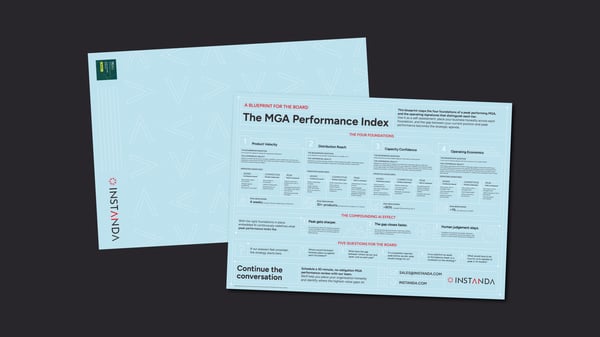
Distribution reach is one of four foundations we see defining the strongest MGAs, alongside product velocity, capacity confidence and operating economics. To see where your own organisation sits across all four, the MGA Performance Index offers a short, board-level self-assessment and an honest read on where your highest-value opportunities lie. It takes under 2 minutes, and it is a useful tool to place in front of your leadership team.