.png)


Ask an MGA leader what their biggest constraint is, and very few will say "ideas." The specialist insurance market is full of good ideas, sharp reads on emerging risk, and genuine appetite to move into new lines. The constraint is rarely the idea. It is the distance between having it and acting on it.
For a long time, that distance was tolerable. In a hard market, a product that took nine months to launch could still be profitable when it landed since rates were rising and the window stayed open. That is no longer a safe assumption. As the market softens and competition sharpens, the window between spotting an opportunity and capturing it is closing fast.
Getting to market quickly still matters enormously. But here is the shift every MGA leader should be encouraged to sit with: fast launch, on its own, is no longer the differentiator it once was. To some degree, it has become table stakes. The advantage that endures, and that far fewer businesses genuinely have, is speed to change: the ability to pivot a live product, rerate, adjust rules, enter an adjacent segment and respond to what the market is telling you, again and again, long after go-live.
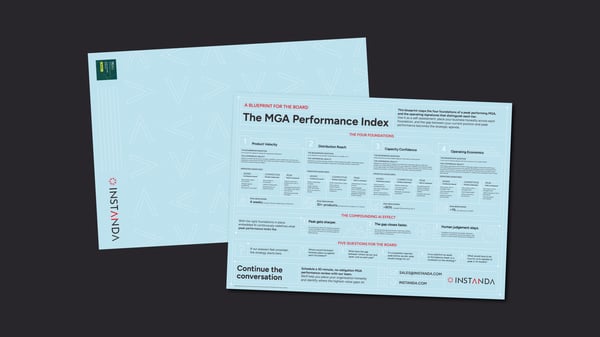
This is the first of the four foundations we see separating peak-performing MGAs from the rest: product velocity. And it is worth being precise about what it means, because it is easily reduced to "launch fast" when the opportunity is something more durable.
The real test comes after go-live
Product velocity is about removing the structural friction that sits between an underwriting team's judgment and the market, both at launch and, just as importantly, every time that judgment needs to change afterwards.
That second part is where the real friction usually hides. In many MGAs, launching a new product is a project: engineering time, a development queue, months of effort. But the more telling constraint reveals itself after go-live. Changing a rate is another request. Adjusting a rule is another wait. Reacting to a claims trend, tightening appetite in a deteriorating segment, or flexing a product to chase an emerging opportunity all mean joining the same queue again. The underwriting team, who understand the risk better than anyone, are dependent on a technical function to translate every change of intent into something the market can buy, and the market rarely waits.
Peak performers have inverted that relationship. The underwriting and product teams configure the product themselves, and technology enables rather than gates, not just for the first launch but for every change that follows.
The benchmark we see among the strongest MGAs is a first product live in a matter of weeks, with each subsequent product faster than the last, and, critically, the freedom to change a live product in minutes and hours not days and weeks. Launch speed opens the door. Change speed is what lets you keep walking through it as conditions shift.

What this looks like in practice
Consider Great Plains Casualty, a North American MGA operating in complex commercial trucking, one of the more technically demanding corners of the market; the underwriting logic is intricate and the risk selection matters enormously.
Great Plains launched its products on a configurable platform within four months, and then, crucially, expanded into 19 additional states almost immediately after go-live. That second number is the one that tells the real story. Getting live is one thing. Being able to adapt the product to the requirements of 19 new jurisdictions, at pace and without rebuilding each time, is speed to change in action. The company built straight-through processing into the heart of the product, which meant the underwriting logic was enshrined in the system itself, so that when it needed to flex for a new state, that was a configuration the business could make, not a project it had to commission.
Or take Farmsure Underwriting, an MGA that moved its Farm Combined product onto INSTANDA. Changes that had once taken weeks began taking hours. That shift is not a marginal efficiency; it is the whole point. This level of capability changes what the underwriting team can do with their day. It lets them respond to a broker enquiry while the opportunity is still warm, adjust a rate or a rule in response to what the book is telling them, and treat a product as something living that they steer continuously, rather than something fixed at launch and revisited when engineering capacity allows.
Neither of these is a story about technology. They are stories about businesses that wanted the flexibility to change as fast as their market does, and removed the obstacle that was holding them back.
Why it matters more as the market softens
There is a temptation, when rates are falling and margins are under pressure, to batten down the hatches and slow the pace of change. It is an understandable instinct, but one to gently caution against.
A softening market rewards MGAs that can find and occupy the profitable niches faster than their competitors, and then adjust as conditions move underneath them. If a new opportunity emerges, an underserved segment, an emerging risk, a gap left by a retreating carrier, the MGA that can stand up a compliant product in weeks will capture it. But the market will not hold still once it has. Loss trends shift, competitors respond, appetite tightens. The MGA that can rapidly rerate, retighten and repivot its live product will hold the ground it took. The one that must queue for every change will watch its advantage erode.
There is a second, subtler benefit. The ability to change quickly is also the ability to learn quickly. An MGA that can put a product in front of the market, see how it performs, and adjust within days is compounding knowledge at a rate a slower business simply cannot match. Every iteration teaches it something, and it can act on that lesson before the next quarter, let alone the next year. Over a cycle, that difference is enormous.
An honest question for your own business
This is not really a technology question. It is about a capability, and every MGA has it to some degree. The useful exercise is to place your own business honestly on the spectrum, benchmarking it against two questions:
- If a new product idea landed on your team's desk this morning, well understood, with appetite and a distribution route, how long would it take to reach the market?
- Once that product is live and the market moves, how quickly can you change it? If a rate needs to shift, a rule needs tightening, or a segment needs a different approach, is that a configuration your own people can make this week, or a request that joins a queue?
The first question tells you whether you can compete. The second tells you whether you can stay ahead. Together they reveal a great deal about where you sit on this foundation, and how much competitive ground your current operating model is quietly costing you.
See how you’re performing
Product velocity is one of four foundations we see defining the strongest MGAs, alongside distribution reach, capacity confidence and operating economics. To see where your business sits across all four, theMGA Performance Index offers a short, board-level self-assessment and an honest read on where your highest-value opportunities lie. It takes under 2 minutes to complete and gives you a good stir on where you could sharpen your performance.