There is a question every MGA will eventually be asked by the people who back it and changing market conditions are bringing it forward for a great many. The question is this: when you look at your book, what does your data prove?
MGAs have always earned their capacity on the strength of their underwriting. That expertise is not in question; the specialist knowledge that sits inside a good MGA is precisely why the delegated model has grown to account for close to 40% of Lloyd's premium. What is changing is not the quality of MGAs, but what the market now asks them to be able to show. As delegated authority has scaled, the conversation with capacity providers has become more data-rich and more forward-looking. Loss-ratio trajectory across underwriting years, the depth and immediacy of the management information an MGA can produce, and the strength of its controls are all rising up the agenda.
This is the third foundation of a peak-performing MGA, and in the current market it may be the most consequential: capacity confidence. It is, at its heart, about whether your data can evidence your value.
The shift from retrospective to real-time
For a long time, the reporting rhythm across the market was necessarily retrospective, because that is what the available tools enabled. Management information arrived at month-end, often assembled by hand. Loss ratios were understood once a period had closed. That was simply the technology of the time, and skilled underwriters made excellent decisions within those limits.
What has changed is what is now possible. A capacity provider deciding where to deploy an increasingly precious balance sheet naturally values discipline and trajectory alongside history. They want confidence that an MGA understands its portfolio as it evolves, can see a trend developing before it becomes an issue, and can bring live data to the table. The good news is that the capability to do exactly that is now well within reach, and the strongest MGAs are already making the most of it.
Those MGAs have moved from month-end to real-time. They have live visibility of their portfolio, they track loss ratio as a forward-looking signal as well as a backward-looking report, and they arrive at carrier conversations with evidence-led confidence. Crucially, for MGAs growing across multiple lines or divisions, they present to capacity providers as one coherent proposition rather than a collection of separately reporting parts. That coherence itself is a signal of maturity.
The same data that reassures a capacity provider also strengthens the MGA's hand in negotiation. An MGA that can demonstrate a well-understood, well-performing book from real-time evidence is in a far stronger position to secure the terms, the limits and the long-term commitment it wants. Increasingly, we see capacity providers offering multi-year binders to the MGAs that can prove their discipline, precisely because that evidence reduces the provider's uncertainty. Data confidence, in other words, converts directly into commercial leverage.
What good looks like
Consider HFIS, an established UK MGA that re-platformed its Total Landlord Insurance proposition. The headline growth number is impressive in its own right: a 44% increase in new policies within twelve months. But the number that also draws a capacity provider's attention is an 80% increase in the volume of data the business captures.
More data, better structured and available in real time, means richer customer insights, sharper decisioning, and a stronger evidence base underneath every conversation, whether with a customer, a broker or a carrier. It is the difference between telling your capacity provider that your book is performing and being able to show them, with current data, exactly how and why.
Why the timing is crucial
It is worth understanding why this foundation has risen in importance now. As the delegated model has grown, capacity providers have quite reasonably become more sophisticated in how they assess and support it, and a softening market naturally sharpens that focus. The more central MGAs become to how risk reaches the market, the more their partners want rich, timely insight into the books they are backing. That is a healthy development, and one the best MGAs are well placed to turn to their advantage.
The question to sit with
So here is a question worth putting to your own team, in a constructive spirit. If your most important capacity provider asked, today, to see the current trajectory of your loss ratio and the real-time state of your portfolio, how readily could you show them? Instantly, from live data? Or would it take a little assembly first?
The distance between those two answers is the distance between performing competitively and at peak. Closing it is one of the most valuable things an MGA can do to strengthen its hand with the partners who matter most.
See how your MGA is performing
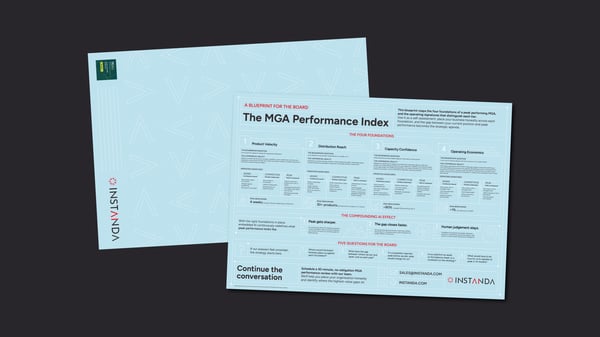
Capacity confidence is one of four foundations we see defining the strongest MGAs, alongside product velocity, distribution reach and operating economics. To see where your business sits across all four, the MGA Performance Index offers a short, board-level self-assessment and an honest read on where your highest-value opportunities lie. It takes under 2 minutes, and it is designed to inform exactly the kind of strategic conversation this foundation demands.